Sunday, September 13, 2015

I try my best to be just like I am…

I heard Bob Dylan's Maggie's Farm on NPR recently, and these lines especially struck me:
Well, I try my best
To be just like I am
But everybody wants you
To be just like them
A worthy endeavor, that. But it's difficult. As Thomas Merton wrote:
We cannot be ourselves unless we know ourselves. But self-knowledge is impossible when thoughtless and automatic activity keeps our souls in confusion. In order to know ourselves … we have to cut down our activity to the point where we can think calmly and reasonably about our actions.
Merton, No Man Is an Island (1955) 7.8 (p. 126)
Thoughtless and automatic activity: that'll keep us from knowing who we are, what we actually admire, what we want to become.

Tolstoy's Ivan Ilych was bedridden as he neared death; I think this enforced reduction in activity was part of how he discovered the vanity in his life:

It occurred to him that what had appeared perfectly impossible before, namely that he had not spent his life as he should have done, might after all be true. It occurred to him that his scarcely perceptible attempts to struggle against what was considered good by the most highly placed people, those scarcely noticeable impulses which he had immediately suppressed, might have been the real thing, and all the rest false.
The Death of Ivan Ilych by Leo Tolstoy, XI (p. 55)
trans. Louise and Aylmar Maude
http://opie.wvnet.edu/~jelkins/lawyerslit/stories/death-of-ivan-ilych.pdf
(downloaded September 2015)
Ivan Ilych's life was certainly not as busy and distracted as the life of a middle-class Millennial, but he kept busy enough with his work and social engagements. It was only when those distractions were curtailed, and when he contemplated his suffering, that he realized that the only real thing in his life may have been the feeble impulses to resist the values of high-status people—impulses which he'd immediately suppressed anyway.

If I do not know who I am, it is because I think I am the sort of person everyone around me wants to be. Perhaps I have never asked myself whether I really wanted to become what everybody else seems to want to become. Perhaps if I only realized that I do not admire what everyone seems to admire, I would really begin to live after all.
Merton, op. cit. 77.8 (pp. 125f)
Ivan Ilych didn't know who he was, really; he didn't know what he actually admired. His folly was also Merton's at times, and I dare say ours as well.

Does it matter, really, if we know ourselves? In the introduction to No Man Is an Island, Merton writes that it's quite important—that it's part of salvation, part of what everyone seeks:

What every man looks for in life is his own salvation and the salvation of the men he lives with. By salvation I mean first of all the full discovery of who he himself really is. Then I mean something of the fulfillment of his own God-given powers, in the love of others and of God.
Merton, op. cit. p. xv
He has more to say about salvation, but he lists self-discovery first. I've been thinking lately about "salvation" so I found Merton's comments particularly interesting.

When he says "salvation," what is he talking about? What are we being saved from? We need to be saved from a life Merton describes here:

Why do we have to spend our lives striving to be something that we would never want to be, if we only knew what we wanted? Why do we waste our time doing things which, if we only stopped to think about them, are just the opposite of what we were made for?
op. cit. 7.8 (p. 126)
There is an even more basic thing we need: we need to know that we are loved by God. We need to know that we're not perfect, and we need to know that it's okay, because nobody is. We need to know that life doesn't consist in possessions or status or even physical health.

And so we must disconnect from thoughtless and automatic activity once in a while. We need to take time for what's important, to tend to our souls. To have unscheduled time. As Buechner wrote in Secrets in the Dark, there are times when it is quiet and you don't really have to do anything, when

[t]he time is ripe for looking back over the day, the week, the year, and trying to figure out where we have come from and where we are going to, for sifting through the things we have done and the things we have left undone for a clue to who we are and who, for better or worse, we are becoming. (59)
Rather than doing the usual thing, once in a while we need to look back, to consider the clues about who we are and who we are becoming.

I'm doing that now, particularly as I try to adjust to the idea of a world where my earthly father no longer lives.

Another memory of Dad

I took a right turn and heard a thumping from the trunk. It was a big roll of paper, "butcher paper" I think, that we used for covering tables for yesterday's lunch reception. The sound reminded me of something Dad told me.

"Did Dad ever tell you that story about the bottle in the trunk?" Neither Mom nor my sister Donna had heard it.

I guess he was still single when this happened, so probably more than 60 years ago. He and a friend were driving, and there was a bottle or something in the trunk. They turned a corner and heard this Bah-dum-bah-dum-bah-dum from the trunk. They found this amusing. "Hey, that's pretty good!" They checked for traffic and swerved left.

Bah-dum-bah-dum-bah-dum. Swerved right. Bah-dum-bah-dum-bah-dum

Pretty soon another sound was heard: a siren, accompanied by flashing lights in the rear-view mirror. They pulled over.

"Lemme smell your breath!" The cop was not pleased.

"The steering seemed a little loose," my dad said.

After checking his license and registration, the cop let them go. "Next time test your steering in a parking lot," he growled.

Is that the kind of thing to tell your son, but not your wife or daughter?

Saturday, September 12, 2015

Dad: some notes

Dad's memorial service was today. They asked me to do the bio—but then… well:
I was asked to do the biography, but since that's printed in your bulletins, I'll elaborate [on it], and start the remembrances early.

Dad was born August 6, 1923 in Fairview, Oregon. He never knew his mother; she died before his 2nd birthday. As a single father overwhelmed with a farm to run, Grandpa Kyung Soo sent little Arthur away to the "Waverly Baby Home." There, Art unfortunately learned something of racism and the dark side of human nature.

One day, a strange man came to retrieve Art from the institution. Art was so afraid of this stranger that on the train ride home, he couldn't bring himself to ask for the bathroom. You can imagine what happened next. Grandpa asked Art why he didn't say anything; when he heard about Art's fear, he spoke kindly to him.

Art moved to Honolulu in 1941 to live with sister Louvie and her husband Kenneth, now both deceased. He wrote home that he got seasick on the boat ride, and that Kenneth seemed to be "a good egg." Then December 7th came.

Dad worked for the Army as an electronics instructor, first as a draftee and later as a civilian. He had an interesting and varied career before the FAA. He was the engineer at the UH radio station near Date and Kapiolani. He sold insurance, which is how he met our mom. They would have celebrated their 60th anniversary next month.

Dad had quite the sense of humor. One day, back when Mom was, ah, "great with child" (me I think), she had lunch with Dad downtown. They were heading their separate ways -- she was on an escalator -- and he called out, "Don't tell your husband."

The FAA would send Dad to school on the mainland, sometimes for months. Mom would record audio letters to him, and include voices of us kids on them. These were small reels of 1/4" magnetic tape.

On one of these stays on the mainland, Dad had an idea. "Hey fellas," he told his classmates, "Let's move our chairs forward 2 inches." They did this every day for a week or two. One morning, the instructor turned around to walk to the blackboard and bumped into it instead. He told me this story just a couple of months ago, in July.

Dad didn't preach a lot, but he impressed upon me the idea that there are other perspectives than mine. "That's a funny-looking caterpillar," I remarked once. I might have been four or five. "You probably look pretty funny to him too, Son," he replied. Indeed.

Way back, when all of us kids were still living at home, Dad habitually went to the blood bank. He'd call out, "going to give blood" before driving off. I don't know how many gallons he gave. I learned from him that giving blood is something that a man does. Part of why I give blood today is that I wanted to be like him. Still do, in fact.

Dad lived a generous and loving life. My wife often recalls meeting him before our wedding. At first sight, Dad said to her, "Here's the girl that's making my son so happy!"

Back when he was only in his 80s, he taught computer skills at HCC. It wasn't for the money. He was always fixing something for somebody.

He also volunteered a lot at this church. In fact he was about 10 feet above the concrete floor of the Parish Hall here, when the ladder slid out from under him; that's how he broke his back.

After that, I heard him praying more. In one of those prayers he was thankful for that experience because it brought him closer to God. When we say Dad never stopped learning, we don't just mean technology.

Oh, and he didn't stop volunteering at the church after that incident either. I learned that a man doesn't stop giving and helping just because of some inconvenience.

Dad was diagnosed with prostate cancer in the summer of 2014, and that was when I finally realized that he might die some day. He had surgeries, and courses of various medicines. He's had a few health crises, and we all knew the end was coming soon. When I last visited, he was very interested in what happens after this life.

The past couple of weeks have been quite frightening, but he'd been improving until Monday; none of us expected we'd be gathered here quite so soon.

But how can we complain? We've all had our lives touched by this wonderful man; I had the distinct pleasure of having him for my dad, of learning from his example and seeing him enjoy his long life.

I can hardly believe he's gone, and sometimes I can barely hold myself together. But then I remember that one of his fondest wishes was that we survive him. So even in our grief, we can rejoice with him that his wish was granted.


That's basically what I said. I wish you could have known him.

Update: And now you can, a little

through some short videos made by his super-talented granddaughter Jana (my niece):
  • Arthur W. Park Memorial Video
    Through this video, I hoped to allow Grandpa to "speak" at his own Memorial Service. Although tears were shed, there was so much laughter, just the way Grandpa would want it. Hope you all enjoy this! (w/clips from the many commercials/films he's starred in!)
  • "Arthur" (Championships Winner: Showdown in Chinatown 2015)
    Published on Nov 9, 2014
    We had less than 3 weeks to make this film, starring 91-year old korean-American senior, Arthur Park, and shot in Honolulu, Hawaii.

Saturday, September 05, 2015

Forwarding non-web email (but not spam) to another address while traveling

We might be the last dinosaurs in California that use a non-web email service, but just in case we aren't, here's the problem and solution. At least I hope the solution works; I'm gonna document it here while developing…

Email arrives at our ISP, and fetchmail(1) brings it to our home using POP over a port forwarded with ssh(1). Here at home, the MDA is procmail(1), which may (it does in my case) sort the inbound messages into folders in maildir format. We read our home email using Thunderbird/Linux or Mail.app/OS X or the IOS Mail thing. These MUAs talk IMAP to the server (dovecot(1) running on Mac Mini). All this works great until we're out of the area.

The lovely Carol will be out of town for a while, and she wants me to send email to one of her webmail accounts (gmail, yahoo, etc.)—but only email originating from an address in her Address Book.

Fly-in-the-ointment #1

She uses Mail.app on both a Macbook Air (portable) and iMac (desktop). These MUAs see the same messages (folders, etc.) because they manipulate email on the server. But that's it! Meaning that each mail client has its own address book. In addition, the Mini is running OS X 10.10.3, where the addressbook is called "Contacts" whereas the MBA runs 10.6.8, where addressbook is called "Address Book."

Address list #1

Starting with the mini, we go into Contacts and say File⇒Export... and select "export archive" or something like this. This creates a new directory named "Contacts - MM-DD-YYYY.abbu" or something like this. In that directory is a file named "AddressBook-v22.abcddb". And file(1) reports that it's a
Contacts - 09-05-2015.abbu/AddressBook-v22.abcddb: SQLite 3.x database
I copied it to my homedir and then had to go get sqlite3.
collin@p64:~$ sudo aptitude install sqlite3
collin@p64:~$ sudo aptitude install sqlite3-doc
collin@p64:~$ 
Then I had to learn how sqlite3 works. Fortunately I've used mysql before, and I could always rtfm...
collin@p64:~$ man sqlite3
SQLITE3(1)                                                          SQLITE3(1)

NAME
       sqlite3 - A command line interface for SQLite version 3

SYNOPSIS
       sqlite3 [options] [databasefile] [SQL]

SUMMARY
       sqlite3  is  a  terminal-based front-end to the SQLite library that can
…
Yippee! Now let's see what's there…
collin@p64:/mnt/home/collin$ sqlite3 from-carol/AddressBook-v22.abcddb 
SQLite version 3.7.13 2012-06-11 02:05:22
Enter ".help" for instructions
Enter SQL statements terminated with a ";"
sqlite> .databases
seq  name             file                                                      
---  ---------------  ----------------------------------------------------------
0    main             /mnt/home/collin/from-carol/AddressBook-v22.abcddb        
sqlite> .tables
ZABCDALERTTONE                  ZABCDPOSTALADDRESS            
ZABCDCALENDARURI                ZABCDRECORD                   
ZABCDCONTACTDATE                ZABCDRELATEDNAME              
ZABCDCONTACTINDEX               ZABCDREMOTELOCATION           
ZABCDCUSTOMPROPERTY             ZABCDSERVICE                  
ZABCDCUSTOMPROPERTYVALUE        ZABCDSHARINGACCESSCONTROLENTRY
ZABCDDATECOMPONENTS             ZABCDSOCIALPROFILE            
ZABCDDELETEDRECORDLOG           ZABCDUNKNOWNPROPERTY          
ZABCDDISTRIBUTIONLISTCONFIG     ZABCDURLADDRESS               
ZABCDEMAILADDRESS               Z_16PARENTGROUPS              
…
sqlite> .schema ZABCDEMAILADDRESS
CREATE TABLE ZABCDEMAILADDRESS ( Z_PK INTEGER PRIMARY KEY, Z_ENT INTEGER, Z_OPT INTEGER, ZISPRIMARY INTEGER, ZISPRIVATE INTEGER, ZORDERINGINDEX INTEGER, ZOWNER INTEGER, Z21_OWNER INTEGER, ZADDRESS VARCHAR, ZADDRESSNORMALIZED VARCHAR, ZLABEL VARCHAR, ZUNIQUEID VARCHAR );
CREATE INDEX ZABCDEMAILADDRESS_ZADDRESSNORMALIZED_INDEX ON ZABCDEMAILADDRESS (ZADDRESSNORMALIZED);
CREATE INDEX ZABCDEMAILADDRESS_ZADDRESS_INDEX ON ZABCDEMAILADDRESS (ZADDRESS);
CREATE INDEX ZABCDEMAILADDRESS_ZOWNER_INDEX ON ZABCDEMAILADDRESS (ZOWNER);
sqlite> select ZADDRESSNORMALIZED from ZABCDEMAILADDRESS;
foo@bar.com
…
That's right: there came a whole slew of email addresses. These are "good" ones.

Combine with address list #2

List #2 is "Address Book" from the MBA running 10.6.8; we export the archive somewhere and get a directory named "Address Book - 2015-09-05.abbu", which contains a file also named "AddressBook-v22.abcddb"; I saved this to a different name, actually "MBA-AddressBook-v22.abcddb", and moved the one from the mini to "miniAddressBook-v22.abcddb", whence it was time to create a combined address list. Like this:
collin@p64:~/tmp$ DBs=$HOME/from-carol/*.abcddb
collin@p64:~/tmp$ for F in $DBs; do \
   echo "select ZADDRESSNORMALIZED from ZABCDEMAILADDRESS;" | sqlite3 $F; \
done
…all done under script(1) Then take the output from that... which may contain whitespace, and also entries like
[16-bit characters] <some@addr>
To deal with that, do this:
collin@p64:~/tmp$ grep @ typescript | grep -v "<" | tr -d ' ' > a1
collin@p64:~/tmp$ grep @ typescript | grep '<' | cut '-d<' -f2 | cut '-d>' -f1 | tr -d ' ' >> a1
collin@p64:~/tmp$ sort -f a1 | uniq > a2
collin@p64:~/tmp$ less a2
That yielded some stuff I don't like, such as:
collin@p64:~/tmp$forFin$DBs;doecho"selectZADDRESSNORMALIZEDfromZAB^MCDEMAILADDRE
A little tweaking covered the bad addresses...
collin@p64:~/tmp$ grep -ve p64 -e / a2 > a3
collin@p64:~/tmp$ 
One more thing: because it was a script(1) output, we need to get rid of the '\r' characters, shown below as 0d. We can do it like so:
collin@p64:~/tmp$ head -n1 a3 | hexdump -C
00000000  31 30 31 36 36 31 2e 33  30 33 33 40 63 6f 6d 70  |101661.3033@comp|
00000010  75 73 65 72 76 65 2e 63  6f 6d 0d 0a              |userve.com..|
0000001c
collin@p64:~/tmp$ view a3
collin@p64:~/tmp$ tr -d '^M' a3 > a4
tr: extra operand `a3'
Only one string may be given when deleting without squeezing repeats.
Try `tr --help' for more information.
collin@p64:~/tmp$ tr -d '^M' < a3 > a4
collin@p64:~/tmp$ head -n2 a3 | hexdump -C
00000000  31 30 31 36 36 31 2e 33  30 33 33 40 63 6f 6d 70  |101661.3033@comp|
00000010  75 73 65 72 76 65 2e 63  6f 6d 0d 0a 31 30 33 33  |userve.com..1033|
00000020  35 33 2e 32 33 31 30 40  63 6f 6d 70 75 73 65 72  |53.2310@compuser|
00000030  76 65 2e 63 6f 6d 0d 0a                           |ve.com..|
00000038
collin@p64:~/tmp$ head -n2 a4 | hexdump -C
00000000  31 30 31 36 36 31 2e 33  30 33 33 40 63 6f 6d 70  |101661.3033@comp|
00000010  75 73 65 72 76 65 2e 63  6f 6d 0a 31 30 33 33 35  |userve.com.10335|
00000020  33 2e 32 33 31 30 40 63  6f 6d 70 75 73 65 72 76  |3.2310@compuserv|
00000030  65 2e 63 6f 6d 0a                                 |e.com.|
00000036
collin@p64:~/tmp$ 
Now we have a file of known good addresses. Let's put them where Carol's procmail can find them.
collin@p64:~/tmp$ cp a4 $HOME/../carol/from-collin/known-good-addresses.txt
collin@p64:~/tmp$ 
So far so good. Then on the mini:
mini1:~ collin$ sudo su - carol
mini1:~ carol$ mv from-collin/known-good-addresses.txt Maildir/  
mini1:~ carol$ ls -o Maildir/kn*
-rw-r--r--  1 collin  15377 Sep  5 15:51 Maildir/known-good-addresses.txt
mini1:~ carol$ 
Whoops! Carol doesn't want a file owned by me, to refer to.
mini1:~ carol$ cp Maildir/known-good-addresses.txt Maildir/known-good-addresses.2015-09-05.txt 
mini1:~ carol$ ls -l Maildir/kn*
-rw-r--r--  1 carol   _lpoperator  15377 Sep  5 15:54 Maildir/known-good-addresses.2015-09-05.txt
-rw-r--r--  1 collin  _lpoperator  15377 Sep  5 15:51 Maildir/known-good-addresses.txt
mini1:~ carol$ mv Maildir/known-good-addresses.txt ~/from-collin/
mini1:~ carol$ ^Dlogout
skipping clear
mini1:~ collin$ 

Now to tell procmail about that

I'm just gonna write this...
    1   # auto-forward to ALT DEST?
    2   :0
    3   * AUTOFORWARD ?? yes
    4   {
    5       VERBOSE=yes LOGABSTRACT=yes
    6   
    7       KNOWNGOOD=known-good-addresses.2015-09-05.txt
    8       ALT_DEST=redacted@redacted.com
    9   
   10       SENDIT=no
   11   
   12       :0 Whc
   13       | formail -zxfrom: -xsender: | grep -qif $KNOWNGOOD
   14   
   15       :0 a
   16       { SENDIT=yes }
   17   
   18       :0 EWhc
   19       | formail -rzxto: | grep -qif $KNOWNGOOD
   20   
   21       :0 a
   22       { SENDIT=yes }
   23   
   24       :0 c                ← See below for workaround
   25       * SENDIT ?? yes
   26       ! $ALT_DEST
   27   
   28       VERBOSE=no
   29   }
Added to Carol's .procmailrc. Here's what it does.
  • Line 3 basically says not to bother with lines 4-29 unless "AUTOFORWARD=yes" appears somewhere before here.
  • Lines 7-8 set some values that we'll use later. We'll refer to them as $KNOWNGOOD and… well, you get the idea
  • Line 12 says that this recipe:
    • W: must Wait for the pipe (line 13) to complete and check the exit code;
    • h: pass only the header to the recipe
    • c: continue (i.e., don't terminate) in case the pipe is successful
    and line 13 takes the header and passes it to formail(1). We then check the from: and sender: fields for a match with the $KNOWNGOOD list.
  • Lines 15-16 say: if we ran line 13 and it was successful (that's the "a" on 15), then set variable SENDIT to "yes"
  • Lines 18 says that this recipe:
    • E: will run only if we did not execute line 16
    • W, h, c: as line 12
    and line 19 tells formail to create a reply, then remove the "to:" field from said reply, then check (grep) the result against $KNOWNGOOD
  • Lines 21-22 are like 15-16
  • Line 24 says to continue on success (as explained for line 12);
    line 25 says keep going only if SENDIT was set to "yes"
    and if so, run line 26, which forwards the email to $ALT_DEST... which now that I think of it will probably fail sometimes.
    Fly-in-the-ointment #2
    Because if the email came from, say, yahoo.com, we're now going to forward it using our ISP's mail server. So the email address at $ALT_DEST will see an email, supposedly from yahoo.com, coming from our ISP and not from any authorized sender of yahoo.com-originated email. That violates sender psomething framework (SPF) and the mail will either bounce or get spam-filed. Urp! I'll figure out a fix later... Time now to make dinner.
  • You can ignore lines 5 and 28; that's "For Nerds Only"
I did a quick test, and at least to an initial approximation "basically, it works." I haven't tried either a "sender" or a "address in reply but not in 'from'" test, but those are pretty rare; I guess I could claim they're there only for completeness...

Workaround for fly-in-the-ointment #2

OK, replace lines 24-26 with the following to resolve the SPF issue. And I think… yep, it's Sender Policy Framework:
24          :0
25          * SENDIT ?? yes
26          {
27      
28              :0
29              * ^From: *\/.*
30              { FROM=$MATCH }
31      
32              :0 fhw
33              * FROM ?? @(facebook|google|gmail|aol|yahoo).com
34              | formail "-iReply-To: $FROM" "-iFrom: redacted@redacted (See Reply-To)"
35      
36              :0 c
37              ! $ALT_DEST
38          }
Here's how it works.
  • 24 is the usual beginning of a procmail recipe. Initially I tried ":0c" here but that resulted in some odd messages and non-functioning. I suspect another procmail+MacOS issue but didn't want to take more time to investigate that; it might be the 4th fly in the ointment… In any case, I coded no "c" here.
  • 25 says to do lines 26-38 only if we set SENDIT to "yes" (i.e., in 16 or 22)
  • Lines 28-30 let us find who the sender is. Normally I would say something like
    FROM=`formail -zxfrom:`
    or maybe
    FROM=`formail -rzxto:`
    but because of fly-in-the-ointment #3, aka the procmail-on-Mac problem documented in https://trac.macports.org/ticket/46623 (and referenced here) that won't work.
  • Line 32 says
    • f: treat the recipe as a filter: that is, modify the message and pass it on to the next recipe.
    • h: pass only the header to the pipe
    • w: wait for the pipe to complete. This ought to be implied for "f" recipes, really, but I'm not sure if it's automatic. I seem to remember being disappointed by this assumption before, but can't say for sure and don't really want to experiment to find out.
  • Line 33 says to do the recipe only if $FROM (set in line 30) matches @facebook.com or @google.com or @gmail.com, etc. The parentheses and the "|" character mean what you probably think they do. One bit of sloppiness here: I should perhaps have escaped the "."; as the recipe stands, an address like "whatever@aolxcommunity" would match. But it's close enough
  • Line 34 fixes the addressing for the email message. First, we put the original "From:" address into the "Reply-To" header.
    Rather than claiming that the message comes from facebook, google, gmail, etc., we'll say that the lovely Carol is sending it from our ISP. That gets past the SPF filters. The "From:" line will remind her, when she sees one of these, to look at the Reply-To: header to find out where the mail really came from.
  • Finally, lines 36-37 send the mail to the alternate destination, which she'll be able to read while on the road. The "c" in line 36 like the "c" in line 12.
I gave this version a quick test, too, and it seems to work.

Thoughts toward the end

Dad is 92, so statistically speaking he’s probably not long for this world. His cancer is metastatic and he’s in the hospital, which only reinforces the prognosis.

We’ve spoken about his approaching end, but as I’ve told many grieving friends and colleagues in the past, one can never actually be ready for it—no matter how long we’ve seen it coming.

What is happening inside me? Well, I have to tell you I’m rather a mess. Dad’s fondest wish is that his descendants all outlive him. Indeed, the alternative would be awful. I know all this, but I’m not actually ready to go through it.

So how am I processing all this? Not very well. And yet part of what’s happening is that I feel compelled to be a better man. When I got Thursday morning’s notice, “You’re eligible to donate life-giving blood!” the urge to run over to the blood center was powerful.

You see, Dad had a habit of donating blood. When I was still living at home, he would sometimes announce, “Going to give blood” before heading to the blood bank. Part of that was prudence: you build up credit, and if you need some units of blood in the future, you don’t have to buy them. I don’t know how many gallons he gave, but it was way beyond what he might ever credibly need. So the savings aspect wasn’t his only motivation. Giving blood, I learned, is something a man does.

And so, with Dad so many steps closer to the grave, I wanted to do something life-affirming—something Dad would do, or rather, something Dad did.

As Phillip stuck the needle into my arm that afternoon, I mentioned Dad’s habit. “Part of why I do this is I wanted to be like him. Still do!” I said, barely retaining my composure.

“That’s what a parent wants,” he returned. Indeed.

Something else is happening to me in these days: when I see young people, my paternal feelings arise a little more strongly than before. Perhaps that Socioemotional selectivity theory is kicking in: 18 months ago I felt like I’d live forever, but today I know better—that I’m unlikely to double my years. I probably don’t have even four decades left.

I can hear some of you laughing: “Four decades? I haven’t even been alive that long!” But I remember my grandmother telling me just the other day, when I six or seven years old, that this world goes by fast. I’m here to tell you that she was right. The other day I reported for work at my first “real” job as a development engineer at hp. That was about four decades ago.
A colleague spoke about a lack of enjoyment in life—particularly his work life. I thought about his words and wrote him a few paragraphs with my thoughts. Another young guy stood up to the boss in a meeting. He wasn’t defiant, but he declined to promise an earlier delivery date for one of his tasks. I wrote him some paragraphs about a similar experience I’d had in my earlier years, and encouraged him to keep up his self-awareness. Bowing to the pressure will only get you in trouble, I told him.

I’m not sure I would have done that two years ago; two years ago I’m not even sure I would have noticed what these guys were saying, or how it was an invitation for me to speak [or write] into their lives.

With young women, my paternal feelings come out even more strongly, perhaps because I have daughters. A young friend is starting a career in elementary education, and as I thought of her energy and her love blessing those kids, it made me feel so happy. I told her so, too.

And that brought to mind the passion and experience that the lovely Carol brings to her lessons, and to young mothers at a church group—I thought about how she’s blessing those students and those young mothers, and that made me happy, too. (I also told her.)

It is good to think about death sometimes, as this article notes. I’m not sure I want to greet each morning with, “It is a good day to die,” but I need to remember that I will die some day, probably before four decades are out. And also to think about people in my life who deserve good words from me—comfort or encouragement—and remember to be liberal with those gifts. If not today, then when? As the Bible says, Do not withhold good from those to whom it is due, when it is in your power to act. And not because something Bad will happen if I don’t, but because doing it will bring good into the world, in and through my life. And because that's what a man does.

Wednesday, August 26, 2015

Finding life… in death

As Ivan Ilych faces death in Leo Tolstoy’s 1886 novella, life seems to him “a series of increasing sufferings” and he does not understand why. As he says to himself,
“If I could only understand what it is all for! But that too is impossible. An explanation would be possible if it could be said that I have not lived as I ought to. But it is impossible to say that,” as he remembered all the legality, correctitude, and propriety of his life. “That at any rate can certainly not be admitted,” he thought, and his lips smiled ironically as if someone could see that smile and be taken in by it. “There is no explanation! Agony, death…. What for?”
The Death of Ivan Ilych by Leo Tolstoy, X (53)
trans. Louise and Aylmar Maude
downloaded July 2015
Some time later, he suddenly sees that it might actually be true—that he had not spent his life as he should have, that the whole arrangement of his life and all his interests might have been false.
He tried to defend all those things to himself and suddenly felt the weakness of what he was defending. There was nothing to defend.

“But if that is so,” he said to himself, “and I am leaving this life with the consciousness that I have lost all that was given me and it is impossible to rectify it—what then?”

op. cit., XI (55)
He finally acknowledges—or, as Tolstoy writes, “it was revealed to him,” that though his life in fact had not been what it should have been, something could still be done to correct the situation. Ivan Ilych accepts the truth about his life, how he has missed the mark; he asks and receives forgiveness, finding relief from guilt and shame even as he dies.

Reading about Ivan Ilych and his repentance put me in mind of a case from Irvin Yalom’s classic text Existential Psychotherapy (Basic Books, 1980). “Bonnie” was a long-time cigarette smoker who had a hard time quitting. Her smoking had destroyed her health and her marriage. What made it difficult for her to decide to stop smoking? In therapy,

one of the important themes that arose was her realization that, if she stopped smoking now, then that would mean that she could have stopped smoking before. The implications of that insight were far-reaching indeed. Bonnie always considered herself as a victim: a victim of Buerger’s disease, of her habit, of a cruel, insensitive husband. But if, in fact, her fate had always been under her control, then she would have to face the fact that she must bear the entire responsibility for her disease, for the failure of her marriage, and for the wreckage (as she put it) of her adult life.
Yalom, op. cit. pp. 320f
(emphasis in original)
Such a realization does not come easily; in Ivan Ilych’s words, it “at any rate can certainly not be admitted.” Thus, a part of Bonnie thwarted her efforts to quit smoking. She wasn’t exactly dying quite yet, but she was divided: she wanted to live, but she didn’t want to recognize her own responsibility for the “wreckage.”

Ivan Ilych had two advantages over Bonnie: First, he saw that death was imminent. According to Carstensen’s Socioemotional selectivity theory, “as time horizons shrink… motivational shifts… influence cognitive processing.” Ivan Ilych’s time horizon shrank precipitously as he understood that he was dying; he had weeks rather than decades ahead of him. I take Carstensen’s theory to predict that as death approaches, it also drives out tolerance for nonsense, as it did for Ivan Ilych: he cast his denial aside.

His second advantage was that he understood that forgiveness was possible. Though not devout, he confesses to a priest.

Yalom mentions neither urgency nor forgiveness in his description of Bonnie’s case: she’s not already dying, and she is offered no relief from whatever guilt and shame she may feel.

What does this mean for you or me? For me at least, it’s helpful to remember that death could come any day (the phrase memento mori comes to mind). Though we all know that death could come any day, we often forget it. Death is an abstract concept, because many of us have decades left; this may as well be forever.

“It is a good day to die” may also be helpful in combating our society’s pervasive death denial. Spoken not only by Star Trek’s fictional Klingon warriors but also by Prairie Home Companion’s real-life host Garrison Keillor, it’s something I said to myself this morning on the train platform.

How is this helpful? As I consider that today could be my last day, I ask myself if I would have any regrets; is there something I need to confess or ask forgiveness for? Or anything else that would make today a bad day vs. a good day to die? Something I could remedy?

Reading Buechner’s Secrets in the Dark (Harper, 2006), I came across his remark about “the temptation to believe that we have all the time in the world, whereas the truth of it is that we do not” (39); and therefore we need to be reminded to be careful with our lives, because they are the only lives we are going to have.

As I think of loved ones whom I’ve outlived or am likely to outlive, I remember many acts of kindness and generosity and love—gifts I happily receive, not only for themselves, but because they call me to be a better person than I am today.

These days I talk with many people who I hope will survive me; I want to give them gifts like those I've received. I want them to know that they’re special; I want them to know that life is not about money and status, but about being who they are and doing what they are called to. I want them to know that they do in fact matter, and that forgiveness and fulfillment and peace are available to them.

Sunday, August 02, 2015

Incident at Rio Grande Gorge Bridge

"Your tire is about flat." The woman had not yet started her car, but came out to have a look.

"Oh, no!" she said. She pulled out her phone.

We were just finishing our lunch at a shady spot near the Rio Grande Gorge Bridge, and the lovely Carol was thinking to spend some time reading. Feeling my "damsel in distress" button pressed, I walked around the car as said damsel was folding up her phone, looking dejected. I made a sympathetic noise, and asked her if she had a spare. She did, "But…"

Carol chimed in around here with "my husband would probably be happy to help." So that's what we did. The damsel (probably about our age actually), who I'll call "Erin," was driving a 2003 Nissan SUV, on which she had never changed a tire. I looked under the car, and saw a full-sized spare. Nice! But Erin was hesitant. It has been quite a while since she'd changed a tire, and had little memory of how to do it. Have I mentioned that she'd pushed my "damsel in distress" button?

Erin opened the hatch and removed some equipment. Under the floor we found some tools: a hex wrench and a rod with a "T" at one end. "Where's the jack?" I wondered, and started to lift the tool tray out. I found some resistance, and after a moment, also found a wing-nut, which I started to loosen. Erin took over, spinning the wingnut counterclockwise while I gradually lifted an edge of the tool tray, and there I found a jack. Success!

I wasn't sure where to place the jack, and I asked Erin if she still had the manual (when all else fails...). Sure enough, she did. I encouraged her to take her time and to follow the order of steps in the manual. There was one thing I forgot to make her do: engage the T-shaped rod to engage the spare-tire winch. But she did it herself at the end—catching my mistake of omission. Other than that, though, she did all the work. I told her what to do and how to do it, and she executed everything.

Carol was very supportive of this effort, noting that I was teaching Erin how to fish, rather than simply giving her one.

As we worked, and for some time afterward, Erin told us about her life and her travels, and also about her niece's travel.

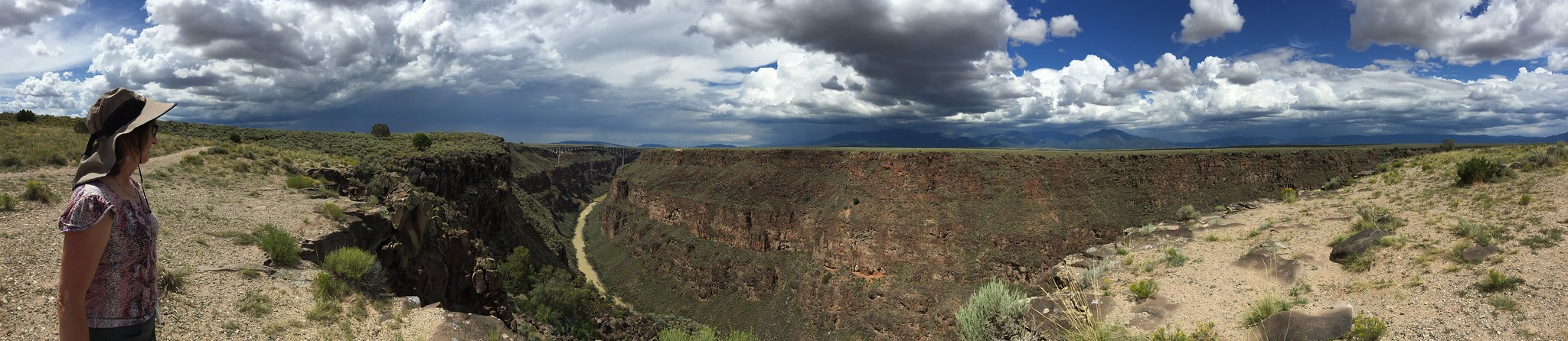
It was a lovely time, and it was nice for me to feel useful on vacation. And we got something out of it, too. Carol asked her whether it was worthwhile to walk across the Rio Grande Gorge Bridge. Erin said it was, but she also recommended a trail that started just behind us. About a half-mile down is a bench, she said, and the view from there is fabulous. We took the half-mile or so walk, and sure enough, the view was well worth the 10-15 minute walk. Photos were taken. Truly a win-win adventure.