Showing posts with label life. Show all posts

Monday, October 25, 2021

What I Did on My Weekend Vacation

I've been working 3-day weeks now for some months. I take Fridays and Mondays off, so it's been consecutive 4-day weekends. What do I do on those weekend vacations?

Today was not typical, but I'll tell you about it anyway. We are friends with a couple who live down the street. On Wednesday, they'll be leaving for several months, so we invited them over for a meal. The plan was for rice and mulligatawny soup for dinner, and a blueberry pie for dessert. I had a vaccination appointment at a nearby pharmacy this morning. There was the checkbook to balance (I do this weekly) and some credit card transactions to review (ditto). I had some email to write, related to our church's activities with/for inmates at CCW (women's jail in Milpitas).

Wow, just reading that makes me feel like taking a nap! Anyway, I took care of the paperwork before my vaccine appointment, then ran over to Costco for a big bag (10 cups) of frozen blueberries. On my way home, the phone rang; I pulled into a parking spot and answered it. The dinner schedule was accelerated by a few hours, so there was no time to fulfill all the requirements of the soup recipe: it was make do with what we had.

Carol and I got to work on the soup as soon as I got home. She cut up some things (carrots, celery, etc. ) and I cut up half an onion, then dredged chicken in flour and sautéed it in butter. I removed the chicken from the pot and cooked the veggies and apple, then added spices, put the chicken back in, and added water. And shredded coconut.

I looked at the clock and put some rice on (the recipe calls for white rice). Then I measured out 4 cups of frozen blueberries, ¼ cup sugar (this was too much), ⅓ cup flour, ½ tsp cinnamon, and mixed them together. I was supposed to mix the dry ingredients and then add the blueberries, but I was in a hurry and muffed that. I was also supposed to add about a teaspoon of lemon juice, but I muffed that, too.

Then the pie crust. I used the pie crust recipe from this 2013 apricot pie recipe, but I mis-remembered the amounts and used too much flour (so that’s why it was so hard to roll out!), but I dumped the filling into the bottom crust, then flopped the other crust on top. I made a half-hearted (maybe ¼-hearted) attempt at a fluted edge, but again I was out of time so I threw it into the oven, forgetting to dot the crust with butter. I set a timer for the pie.

It was time to add a little cream to the soup, so I did that and walked out front for some parsley. While I was picking, our friends arrived, so in we went.

Carol and I worked on getting the table set. I chopped the parsley and threw it into the soup (it was supposed to get sprinkled on top after serving, but I muffed that detail too). I was also supposed to bone the chicken parts, but skipped that because, well, you know, I’m a slacker. And I was out of time.

We all enjoyed the soup. The timer went off, so I popped up to check the pie... no juice visible on top, so I set the timer again. On the second alarm, I just pulled it out.

The soup used up only a little from the shelf-stable whipping cream, so Carol put the rest into the mixer for a nice topping for the pie. It didn’t work, because nobody read the part about “refrigerate six hours before attempting to whip.” So we had a cream sauce over the pie, rather than a whipped topping. The crust was light-years from perfect, but it tasted OK and there were no complaints.

After our friends left for urgent dental care, I looked at the office email. This is a habit I’m trying to break, but well, you know… Anyway, I'm on a rotation with some other folks, and I'm due to be on duty for exactly the two weeks Carol and I will be on vacation. I had not seen that coming! So I emailed an apology, and a request that my colleagues cover for me on this shift in exchange for my working a double shift hwen I get back.

And now I’m typing a blog post on the living-room floor, with the dog sleeping beside me.


ADDENDUM: pie baked 375°F 50 minutes. Or maybe 400°F 35ish minutes
2022-09-09

Saturday, July 25, 2020

Ash Wednesday thoughts

[found on the Notes app on my phone, from February]

It was a good day to die, as Garrison Keillor said of that spring day in Minnesota, with the tomatoes just planted. His aunt was looking over her garden when her heart just decided to stop.

His monologue came to mind today, Ash Wednesday. “Remember that you are dust, and that to dust you shall return,” say the priests. It’s a good thing for me to remember, because like most Americans, I tend to ignore my mortality. But it struck me the other day that I probably have fewer than 10,000 of them left.

Indeed, as I’ve heard a few times recently, “Life is short. We don't have much time to gladden the hearts of those who walk this way with us. So, be swift to love and make haste to be kind.” (attributed to Henri-Frédéric Amiel)

I hope in this Lenten season that I’ll be diligent to do that.


At the end of his monologue, Keillor remarked that it was indeed a good day to die. And if a good day to die, how much more was it a good day to live?

Monday, December 03, 2018

Mom is dying.

She’s been declining for the past 4 years or more, but in the past month or so she’s really taken a nosedive. Last year she lost 28 pounds; by this October, she’d lost another 20. Since then, she lost the next 15. The big C (diagnosed in November) has been part of this, as has vascular dementia, but she’s also lived over nine decades; statistically she wouldn’t be long for this world, even without those ailments.

How am I dealing with all this? Well, I came out for a few days last month, after learning of the diagnosis. And I’m here again today. Yesterday I sat next to her as she dozed on the couch. I tried to get her to drink something, but she wasn’t much interested. Not interested at all in food.

We talked about her memorial service, and I asked her if she had any thoughts about what she wanted read or sung. A favorite psalm perhaps? I quoted the first half-dozen verses of Psalm 139; she shook her head No.

After a while, when I thought she’d forgotten the question, she turned her head toward me and whispered, “Last song, ‘God Be With You’.” I wrote that down.

I brought the fall 2018 issue of the Hedgehog Review with me; its theme is “The Evening of Life.” One article mentions the way we deal with aging in our impoverished (but materially rich) society. It struck me that it’s similar to how we deal with obesity: we pretend that if only you would do this or that, you could age “successfully…” by which we mean you could postpone old age, or cover it up, or compensate for it. But of course it catches up to every one of us, unless we die first.

All this reflects how I deal with big issues: I read, I think. Sometimes, when I remember, I pray. I think about the good times, but more than anything what I do is avoid it. I have a pending code review; even though I’m officially not at work, I nag people to have a look. I return email from someone who’s looking at a defect report I filed. I think about what to work on next.

And I prepare for an interview at a prospective new employer. Forty-two years of history says I’ll never switch employers voluntarily, but if it’s ever going to happen it’ll have to be soon.

This hasn’t been very coherent. But there’s a reason this is called a “blog.”

Sunday, March 18, 2018

Directed Writing

I don't remember the prompt for the first one, but here's what I wrote:

The headlights slowed as they approached, and I took a last drag before flicking the butt into the night.

I stepped onto the cab's ladder to reach the door handle and swung my knapsack onto the floor. “Howdy, and thanks—” I said as I shut the door.

The first surprise was her voice. “Evenin’, stranger,” she said as she steered the 18-wheeler back onto the highway.

Immediately I sat up straighter. “Thanks for stopping, ma’am.”

That got me a guffaw. “Don’t call me ma’am—I work for a living!”

“You navy?” I tried.

“Marines!” she said. “Made sergeant but two tours was enough.”

“Thanks for the lift, Sarge,” I said.

“Where you headed?”

“Anywhere but here. Did some stupid things here. Lost my company, family, house. All I got left is my bones.

“You got a passport?” Sarge glanced at me doubtfully.

“Turns out I do,“ I said. “Needed it for business travel. Not any more, though.”

“Well, sailor,” she said. “This load’s headed for Manitoba. Can you navigate? On land I mean.”

“Sure, Sarge. I was an ensign


I ran out of time there. Here's the next one, addressed to my late father.
It was just the other day I felt the rail scraping the top of my head. I might have let out a yelp. It amused you that I had grown too tall to walk carelessly under that old kitchen table.

Where were we living then, Dad? Was it the year JFK was elected? Were we in Manoa then? I remember the curved tubular steel legs and the leaf in the middle— I don't think I ever saw the table without it.

But I don't recall which way it faced, or whether the girls were born yet.

Nothing profound, just a snapshot—discovering that my head reached the rail, seeing your smile and hearing your chuckle just the other day, not quite 60 years ago.

Saturday, October 14, 2017

An eventful week; a grateful me

The younger ex-teen got married last weekend; it was a celebration of great joy—and also relief.

You see, Grandma Bessie (my mom) was planning to visit us, arriving Tuesday night. But rather than going to the airport, she went to the emergency room due to abdominal pain, severe and unrelenting. My mobile phone exploded with text messages. The phrase “aortic <something>” was heard. X-rays and CAT scans were discussed.

They had me at “aortic”; I started checking flights, but didn’t book anything until the medical folks settled on the diagnosis: aortic aneurysm. I clicked “Book this flight” for Alaska 837, SJC→HNL Wednesday morning.

Wednesday

Am I getting old, or was it just the stress, or have the seats gotten harder? Whatever it was, I was hurting by the time we landed. Inga picked me up and we went straight to Queen’s. Dr. Sato came in and advised Mom to get the endovascular aneurysm repair, maybe like the one decribed here on webmd.

As I heard the story, Mom had said she’d consider it; today the surgeon was recommending it. He itemized a bunch of risks, things that might happen during surgery. They’re not frequent, he said, but they do happen. I asked him what he would recommend for his own mother, if she had a similar condition. Surgery.

He told Mom of a past, younger patient of his. He recommended the surgery, she declined, she went home, the aneurysm ruptured, and she died the same day. Mom was sold, and Dr. Sato indicated that he’d try to do the endovascular aneurysm repair Thursday afternoon.

Then an anaesthesiologist came in, describing how the anaesthesia itself had risks (beyond the surgery), including death! My comment was, we don’t have many alternatives here.

Thursday

In the morning we heard the surgery would be at noon! I ran down to the hospital, having spent the night at “home,” and hung around until they shooed me out. I sat in the waiting room for a while, and then sister Donna said I could join her in pre-op. After some confusion, the nurse and I found each other, and she ushered me in to Mom’s area, where it was freezing. I was impressed by the keep-warm technology.

Mom was mightily bored by all this and kept dozing off, or maybe she just closed her eyes. Eventually they said they were really going to do the surgery, and I snapped a pic just as she was about to go to the “OR.” The photo is dated 1:57pm.

I went home for a nap, and Mom was done about 5:20pm. The surgery had gone well, I heard. I eventually figured out how to get to the surgical waiting room in QE Tower. Quite a few folks were there, sister Inga and nieces and nephew; several of them were still heading to California for the wedding.

They let me into the recovery area after a while, and I joined Donna there. Mom would have to lie flat for four hours, the first two with sandbags on her thighs, to discourage reopening of the surgical incisions (pokes, actually). She wasn’t too happy about that.

I held Mom’s hand for the next 3 hours or so, giving her Bible passages or praying or chatting or just sitting. At some point Donna took my parking ticket to a nurses’ station, where they stamped it for me. I would later find out that the afternoon’s parking would be on the house :).

At the 7:00pm shift change, the new nurse asked Mom if she knew where she was.

“Hospital,” she murmured.

“Do you remember the name of the hospital?”

“Queen’s.”

“Do you know what month and year it is?”

“October,” she croaked.

“And do you know remember the year?”

“Seventeen.” It was barely a whisper.

“Who are these people?” the nurse asked, indicating Donna and me.

“I don’t know!” she said. Very funny, Mom! The nurse wasn’t fooled for a moment.

Some other post-op procedures were needed. An X-ray for example. So the X-ray guy showed up after a while and said something about sitting her up. The nurses updated him on the situation; I didn’t have to tackle him.

Around 10pm the nurse moved her to a private room in QE tower. We were about to exit the elevator on the 8th floor when an EMERGENCY indicator lit up, the doors closed, and the elevator expressed back whence we came.

The doors opened to reveal a nurse with a surprised expression; he released the elevator, mumbling something about grabbing another one, and the elevator returned to the 8th floor. Our nurse explained that some ICU patients must be transported without delay immediately after surgery; they cannot wait.

Mom got situated and after a while, Donna suggested I go home. No argument from me on that.

Friday

The next morning, Dr. Sato dropped by Mom’s room to ask how she was doing. Any pain? Mom shook her head no.

He smiled. “See? Told you!”   He also said, “You can go home today as far as I’m concerned.” No medication needed, but Mom should take it easy the next couple of weeks.

I ran “home” so Jana could take me to the airport. (I had already packed my things.)

My return flight was uneventful, but all too long. Again my seat hurt. The lovely Carol picked me up late Friday night.

Saturday

I’d missed Friday afternoon’s rehearsal, but I was assured all I had to do was follow directions—always a challenge for me, but perhaps it would be OK this time.

Several friends of Peter and Sheri spoke at the ceremony; each one added a unique perspective, so that all of us present got glimpses of both bride and groom. I have to tell you that as much as I respected and esteemed Peter before the ceremony, his friends’ comments made me feel even happier to have him in our family. The celebration was intimate and meaningful and and God-honoring.

By the way, my nephew Keith unobtrusively live-streamed the ceremony; Mom and Donna and Jana and Mom’s great-grandchildren all could see it.

As I said at the reception, “It’s hard to be humble when Peter is your son-in-law!” Oh, and we “facetime”d with Mom at the reception. She looked happy.


I am a very grateful man today. I wasn’t quite in a panic Tuesday, but as I said several times, it was a little too exciting. Aortic aneurysms are often fatal; it was fortunate indeed that Mom had a lot of pain so that she would know to go to the hospital. And it was fortunate that the symptoms appeared before she came to California.

And now both my daughters have husbands that make it impossible for me to be humble.

And it’s also really hard to be ungrateful. My cup is full, even as the nest is empty.

Saturday, April 08, 2017

Beating Loneliness

From “John Cacioppo on How to Combat Loneliness” in the Atlantic weekly:
Khazan: Is there something lonely people should be doing proactively, like going to a book club or soup kitchen?
Cacioppo: Do volunteer service in something that you enjoy. I've developed the acronym EASE—ease your way back into social connections. The first E stands for “extend yourself,” but extend yourself safely. Do a little bit at a time. The A is “have an action plan.” Recognize that it’s hard for you. Most people don’t need to like you, and most people won't. So deal with that, it's not a judgment of you, there's lots of things going on. Ask [other people] about themselves, get them talking about their interests. The S is “seek collectives.” People like similar others, people who have similar interests, activities, values. That makes it easier to find a synergy. And finally when you do those things, “Expect” the best. The reason for that is to try to counteract this hyper-vigilance for social threat.
Or as Isaiah wrote: If you pour yourself out for the hungry and satisfy the desires of the afflicted, then shall your light rise in the darkness and your gloom be as the noonday. And the Lord will bless you continually and satisfy your desires with good things, and make your bones strong… (Isaiah 58)

Wednesday, December 14, 2016

How do you vote?

Frederick Buechner, in his marvelous Secrets in the Dark, recounts a few incidents of the kind Christians like: he receives strange encouragement in a time of stress; an odd phenomenon occurs after a departed friend appears in a dream—this sort of thing. Then he asks us how we would vote on the second most important philosophical question:
On Yes, there is God in the highest, or, if such language is no longer viable, there is Mystery and Meaning in the deepest? On No, there is whatever happens to happen, and it means whatever you choose it to mean, and that is all there is?
Buechner, p. 171sq.
Actually he used the word “bet” (rather than “vote”) but he points out that we actually bet our lives.
We may bet Yes this evening and No tomorrow morning. We may know we are betting or we may not know. We may bet one way with our lips, our minds, our hearts even, and another way with our feet. But we all of us bet, and it’s our lives themselves we’re betting with in the sense that the betting is what shapes our lives. And we can never be sure we’ve bet right, of course. The evidence both ways is fragmentary, fragile, ambiguous. A coincidence can be, as somebody has said, God’s way of remaining anonymous, or it can be just a coincidence. Is the dream that brings healing and hope just a product of wishful thinking? Or is it a message from another world? Whether we bet Yes or No, it is equally an act of faith.
op. cit., p. 172
Indeed, it’s not that Yes takes faith and No takes only courage and reason; it takes just as much faith to vote No as Yes—I might argue it takes more. Bertrand Russell had a lot of faith to bet No, as he expressed in a famous essay:
Man is the product of causes which had no prevision of the end they were achieving; that his origin, his growth, his hopes and fears, his loves and his beliefs, are but the outcome of accidental collocations of atoms; …
I confess mixed reactions to Russell’s view. On one side, if he’s right, then (as the Bible says) “Let us eat and drink, for tomorrow we die”; I can ignore my conscience and exploit anyone for any reason, or no reason …

But Kant says that’s not philosophically consistent, and Mill argues in the generalized version of utilitarianism that it’s a bad idea. Practically, one might feel the need to buy a lot of guns, because if everyone thought and acted that way, it would be like a Wild West sans law enforcement.

But I see two more big problems with Russell’s way of thinking. First, if someone sincerely holds those beliefs, and lives accordingly, what kind of life do they have? What kind of person do they become, if they think that your hopes and fears, your loves and beliefs, are but the outcome of accidental collocations…? A brief thought-experiment tells me that I don’t really want a life like that, and that I don’t want to be around anyone who lives that way either.

Another big problem is, as Lewis wrote, “If thought is the undesigned and irrelevant product of cerebral motions, what reason have we to trust it?” Indeed, Russell claims to be a random text generator, but I don’t actually believe him.

Back to the first question: how do you vote on Buechner’s question? Yes, there is some kind of real meaning in life? Or No, things just happen, and they mean whatever you choose them to mean?

Wednesday, August 10, 2016

Open letter to Amit

The other day, someone at work asked me if I had regrets over choosing a career in tech. Here's my response.
Updates 2016-08-11:
  1. Last night, Kesavan (the unnamed guy below) said it was fine to name him.
  2. This morning, I realized that I'd forgotten to mention something really important, perhaps the most important fact about me: I've been extremely lucky. More on this is in the addendum.

Amit,

Thank you for asking about regrets over choosing a career in tech; your question honors me, and I hope my answer doesn't disappoint.

I think I mentioned that my career began over forty (40) years ago, which is a source of great amusement and sometimes astonishment. A few years back I was in a hackathon with Mohit and Katiyar and Narver and one other guy who I won't name… trying to do something in javascript, which I still don't know. And I was mumbling about how I wish I'd learned it in grad school. "But wait," I said, "when I was in grad school, javascript hadn't been invented yet."

The unnamed guy in our hackathon team said, "I wonder how many of us were even born when Collin was in grad school?" and it turned out he was the only one... which is why I don't include his name here :)

But to your question: do I regret my career choice? Well, after my bachelor's degree I needed to do something to pay for rent and groceries. I wasn't good at anything in school except math and circuits and programming. Maybe I could have gone into statistics or become an actuary or something, but frankly the path into a tech career seemed more straightforward.

I have been thinking recently about something Garrison Keillor said in one of his "Lake Wobegon" monologues: "I wonder if perhaps we are less than our parents, and have given less to our children." I think of my dad, who ran out of money and didn't finish college. He got drafted and taught electronics for a while. He got a radiotelephone license and was engineer at a radio station. He was a sales/support guy for IBM and worked under some pretty unpleasant conditions. He switched to working for the FAA, and had to spend months at a time away from home for training. He went out and found work to do on the side: he fixed and built and invented things. He knew how to learn stuff and made the effort to do it. Car repair, electronic equipment repair, remodeling—he did it all. One day when he was in his 60s, he called a plumber for the first time in his life.

In contrast, I've had an easy life. I've had two professional employers—essentially two professional jobs since college. I haven't had to reinvent myself, I haven't had to take a lot of initiative. Have I had to work long hours debugging something? Sure; everybody has. But that's not the same thing as having to invent myself or figure out my next step in life.

I think what I'd say is that I did the best with what I had and with who I was. Sure, sometimes these days when I speak with our friends who go to Mexico and do medical work, I wish I had gone into that field so that I could help people in a more direct, intense, meaningful way. Given my constraints at the time (private college was expensive, even in the 1970s), I needed to finish quickly and start making money soon.

Could I have switched at some point? Maybe, but things got a lot more complicated with a mortgage and children. Shoulda, coulda, woulda—but I'm no hero or sage; it was enough effort to keep all the balls in the air, without also thinking about making a major change. Like many, I never got dissatisfied enough to consider a career change seriously, until getting laid off in 2002.

At that point, I briefly considered becoming a teacher. However, as I have since learned (from teaching Eng101), it would be a YUGE effort for me to become suited to classroom instruction. Also, with two college educations still ahead, it just didn't seem practical to take a significant drop in income.

So as I think back, my career in tech has been a good fit for me. It's a good fit for my personality and my talents. and has enabled my kids to graduate from college with no loans. My wife has been able to spend a lot of time at home when the kids were growing up, and she's now working on a novel and a collection of poetry. We've had some extra money to give to those less fortunate than ourselves.

Now the content of the work hasn't been really significant in itself. It's not like inventing dwarf wheat (Norman Borlaug did that and saved literally over a billion people from starvation); it's just solving problems and writing stuff.

What has been rewarding in my view is learning stuff and helping others. It's like what does a plant do? It grows, it reaches for the sun, it pulls carbon out of the atmosphere, it drops seeds, it provides shade. In doing that stuff, it brings glory to its maker. I don't know if plants know they're created by God, or if when they do what they do they "feel his pleasure," but I certainly do. Feel God's pleasure I mean. The stuff I do isn't grand or terribly significant in a dwarf wheat kind of way, but when my code works, or when I can help somebody learn something, or encourage someone to try one more time, that's a good feeling.

You're near the beginning of your career, a career that I hope will bring you as much stimulation and challenge and learning and joy as mine has. I suppose I could try to tell you to take more risks than I did, or try more new things, or push yourself upward, but I obviously didn't follow that advice, and I'm not sure it's good advice anyway.

No, what's really important in life, in my view anyway, is to be home for dinner, to play with your kids, to manage your boss's expectations so you can live a balanced life. Because really, who's gonna hold your hand when you die? It's not gonna be your boss, or if you're a manager/director/VP, any of the dozens or hundreds of people below you in the org chart. It's your family and your close friends. The patents, the certificates, the quarterly recognition awards, etc. will be forgotten.

OK, that's way too long. Thanks for reading this far. I'd love to hear your story and your thoughts on all this.

      -collin

Addendum: the role of luck in my story
If when you read the above, you think, "he sure was lucky," I'm here to tell you that you are 100% right. Did I work hard? Sometimes. Did I get good genes from my parents? The smartest thing I ever did was to pick the right parents at the right time in history.

Because all the talent and grit and determination and hard work in the world won't get you far if bombs are constantly falling outside your house, or if there's no electricity and you can't go to school because you need to help your parents gather food, or if your parents died in their 20s from AIDS or ebola or something. Robert Frank made a terrific case for the role of luck in this article in the Atlantic. And in the latest Hedgehog Review, Frank quotes David Brooks:

You should regard yourself as the sole author of all your future achievements and as the grateful beneficiary of all your past successes.... As you go through life, you should pass through different phases in thinking about how much credit you deserve. You should start your life with the illusion that you are completely in control of what you do. You should finish life with the recognition that, all in all, you got better than you deserved.... As an ambitious executive, it's important that you believe that you will deserve credit for everything you achieve. As a human being, it's important for you to know that's nonsense.
The Credit Illusion NY Times 2012-08-02 link

Monday, March 28, 2016

Tears at Easter

I cried a lot yesterday—tears of both joy and grief. I'm not sure why, exactly, but maybe it was just one of those days when the Spirit of God broke through the shell I usually and unthinkingly wear.
Christ the Lord is risen today
    Al-le-lu-ia!
Sons of men and angels say
    Al-le-lu-ia!
Raise your joys and triumphs high!
    Al-le-lu-ia!
Sing, ye heavens, and earth reply,
    Al-le-lu-ia!
For some reason that carol (or is it a hymn?) shook me up. How many hundreds of times have I sung it? Or maybe it wasn't this song, but another one near the start of yesterday's 11:00 service at PCC that got to me.

In one of his Lake Wobegon monologues, Garrison Keillor mentioned a certain "Uncle Mike" who, when asked to pray at Thanksgiving, started by thanking God for forgiveness of sins through Jesus Christ, and then, in talking about how that forgiveness was purchased—viz., through Christ's dying for us on the cross—broke down and started weeping, and there was this awkward interval where hungry people were waiting for him to finish so they could dig in.

Perhaps Uncle Mike wasn't the best choice to pray for everybody, but Mike was more conscious of that spiritual reality than others at the table. They were eager to enjoy God's material and sensual blessings—which are good things—but Mike was focused on God's greatest gift.

Anyway, yesterday would not have been a good day for me to pray in front of a crowd; I was trying not to cry too much during the opening song or songs.

Then came this line in the sermon

I was visiting my parents, who both have Alzheimer's. They're living in a care facility, and I was there holding my father's hand, thinking "What am I doing here? Why did I drive 4 hours…"

Dad can't talk any more, and I remember thinking that I'd give anything just to hear my father talk to me again.

And I said, quietly, "So would I, Gary; so would I." I'm tearing up even now as I recall the moment. (Pastor Gary went on to say that his Heavenly Father came to him at that point and encouraged him about the world to come, but I was for a moment stuck on missing Dad.)

Back in the '80s, Carol and I went to a Crabb/Allender seminar about counseling, where we heard Crabb talk about the ache we have while here on earth. Contrary to the "name it and claim it" talk of the so-called "prosperity gospel," Crabb echoed the message of pain found in Romans 8:

22We know that the whole creation has been groaning as in the pains of childbirth right up to the present time. 23Not only so, but we ourselves, who have the firstfruits of the Spirit, groan inwardly as we wait eagerly for our adoption as sons, the redemption of our bodies.
Romans 8:22f [NIV 1984]
Ain't that the truth! Yes, the Apostle Paul also told us to "Be joyful always" and "Rejoice in the Lord always", but there's this other part, which is also true.

Baptisms

And several folks got baptized yesterday. As the first one came out of the water, my face wasn't quite as wet as his was. I was remembering my friend Ali, who was baptized two years ago. He had come from a country racked by sectarian violence. He told me that he would be called an infidel back home, because he wasn't ready to kill someone in the name of God.

He heard that Jesus is kind, and visited our church, where he heard more about Jesus and decided to follow him. The church office put Ali in touch with me and another man, and we met him a few times and talked about his questions (he had many) and Ali asked how he could become baptized.

Ali was baptized in Pastor Frank's office. He told me about it a week or two after the fact. I told him, "We are brothers!" As indeed we are. Forever.

I also remembered my own baptism, in Half Moon Bay, maybe 37 years ago. I waded into the water, and Pastor Ron asked me, "What's your name?" I answered, and he said, "Collin, based-on-your-profession-of-faith-in-the-Lord-Jesus-Christ, I baptize you in-the-name-of-the-Father-and-the-Son-and-the-Holy-Spirit" as he dunked me into the water. He pulled me out a half-second later and the next person waded toward him.

I was shivering all over, but my heart was warmed by the love of God and the fellowship of my brothers and sisters. That too was a day of great joy. As is today.

This is the day the Lord has made
Let us rejoice and be glad in it.
Psalm 118:24 (approximately)

Tuesday, November 17, 2015

Shivering in the dark at the Caltrain platform: a perspective

The wind felt quite cold as we waited on the Caltrain platform. Due to a fatality near the Santa Clara station, trains would be delayed 60 or 90 minutes.

It turned out to be more like two hours, but as I started feeling uncomfortable, I thought, here I am in a pair of jeans, a scarf, a hoodie and a coat. Even if it lasts another hour, tonight I'll have a hot meal and and sleep in my own bed next to my wife in our warm house.

I thought of the thousands of Syrian refugees, fleeing violence at home, and how much harder it will be for them after those bullies from Da'esh launched the Paris attacks. I mean—imagine it:

You're just trying to feed your family, minding your own business, and one day you start to hear rumors. You're afraid, but what can you do? Then one night you hear doors slamming, screams, gunshots; you gather your family and run like hell. The next day you make your way back to town and find your neighbors and extended family killed. You find another survivor, who tells you that armed men went door to door, killing everyone who didn't have the right kind of family name, or wasn't the right kind of Muslim.

And now a bunch of European countries are telling you to stay out, when all you're trying to do is get away from people who have killed off most of your village.

I think about our United States, how many people came from Europe, fleeing religious persecution of all things, in the 17th century. And in the centuries since, how many more came from all over the world to make new lives for themselves, fleeing poverty and persecution. Some came in search of a better life, or maybe just in search of adventure.

And I am embarrassed today to be a citizen of the same country where so many GOP governors have said they'll take no more Syrian refugees. Yes, some "refugees" are actually terrorists, and some real refugees will become terrorists. But the overwhelming majority—I mean let's be serious—are just trying to stay alive.

And I remember with some bitterness that people like Lee Harvey Oswald, Timothy McVeigh, the Columbine shooters whose names I've forgotten, Adam Lanza, and lots of other mass killers were never refugees.

What is the matter with us?

Wednesday, October 14, 2015

Returning to California: Flight Diary (sorta)

A few happy momenets.

I was kicking myself for not just filling the rental car's tank in Manoa. Not finding a filling station on Lagoon Drive, I used the "Maps" app on my phone to find the nearest station. When I got there, I found out: for military personnel only. By the time I found the Chevron at Moanalua Shopping Center, I should have already been at the airport. So much for trying to be a good citizen by filling up near the airport!

But when I got to the airport, I had no trouble checking my bag because the flight was delayed: about 35 minutes. TSA PreChk made for a less-annoying experience at the checkpoint. My section was the last to be called. On the jetway, a gate agent called out, "Any bags to go, pre-tagged?"

Behind me, the young Japanese father said, "えっ? なんって?" (basically "Huh? What'd she...")

Digging into my latent reservoir, I came up with "お預かり..." --the light of understanding dawned in him--"荷物."

He pulled his bag off the stroller and waved an arm. "Excuse me!"

A few people in front of us chimed in, and we eventually got the agent's attention. "We have a stroller here," I said.

The stroller disappeared, and the young dad gave me his thanks.

A few minutes later, on the plane, he got his wish: a chance to do something to help me. We were almost the last ones on the plane, and I was trying to get my roll-on bag into an overhead bin. The young dad moved some stuff for me and I was able to hoist my bag up and into place. "どうも, お疲れ様" I returned.

I was in 9D, with a Chinese couple seated next to me in 9E-F; 9A was occupied but 9B-C were vacant. I slid into 9C, giving the couple room to spread out, and did a little spreading out myself.

A couple hours later, the beverage cart parked at our row for the third time. The flight attendant was tending to row 11. The lady in 9A was looking up hopefully, so I asked her if she needed anything. "Water," she said, so I watched for an opportunity.

As the flight attendant returned to her cart, I leaned toward her. "When you get a chance," I began.

She stopped and I continued, "...she would like..." and I let 9A speak for herself.

Truly feeling blessed today.

Tuesday, September 15, 2015

Reflections

Dad was admitted to hospital on Monday August 31, and my sister Donna flew to Honolulu Wednesday to be with him. He was confused but improving, and everyone was talking about his recovery/rehab. Still, as the week wore on, I felt a strong desire to be with him. As I wrote earlier, I responded immediately to the blood center's reminder email, and that gave me a sense of connection with Dad. Yet I also wanted to see him in person.

It was September 3rd and I considered the possibilities. We had a plan to meet my daughter and son-in-law and grandson and niece in Felton Monday the 7th (Labor Day), so I wanted to leave after that. The lovely Carol had reservations to fly to Asia on the 17th, so I wanted to return before that. I'd briefly considered flying to Honolulu Monday morning and canceling our plans with the young folks, but since everyone in Honolulu was optimistic, I left those plans intact and planned to fly out Friday 9/11 (an auspicious date).

We enjoyed our time with the young folks on Monday, but our house phone rang that night, close to midnight. Nothing good happens at that hour, and this was when I heard Dad was in a crisis. An hour later he stopped breathing.

I was distressed about this, and wanted to see my mom and sisters immediately. I briefly considered taking the first flight I could get, which would have been about 6 hours later. Instead I opted for a flight out Wednesday morning.

Tuesday morning I went to the office and set up an email auto-reply. I also preemptively told my colleagues that I was leaving due to a death in the family. Several friends (and colleagues) stopped by to convey their condolences. Two gave me the same excellent advice: DO NOT indulge the "what if?"s.

Should I rent a car? I wasn't sure so I texted my sisters.

As I packed, I thought, well, if I had left Monday morning I might have seen him alive one more time. I thought, if I had "facetime"d him Monday afternoon, as my cousin-by-marriage had, I would have talked to him alive one more time. Then I remembered my friends' excellent advice and renounced those thoughts. No one is ever told what would have happened…

Thursday afternoon we had an appointment at the mortuary to look at Dad's body before cremation. I wasn't sure I liked the cremation idea, but when I saw his body (it had been in the 'fridge and condensation was forming at several places) I changed my mind. The past few weeks he had lost quite a bit of weight. I wanted to remember him as he was during my previous visits.

We all wept. We agreed that things could have been much worse: it might have been months in a hospital bed in the house, a life he would not have liked. We knew all this, but still it was hard to accept that he was really gone. A world without my father in it is an idea that repels the mind.

Donna said it was good for us to see him here; without it we might imagine he was just at the hospital or somewhere else. I agreed. It's a necessary shock to force the mind to accept an idea that repels it.

Mom asked if someone could pray, and I said, "Not me; I can't even see." My sister Inga spoke to God for us.

We had a memorial service Saturday: the urn holding his ashes sat on a table in front, with a 20"x30" pic of him nearby. Several people shared their memories of him. I heard things I hadn't known before—things that made me desire even more to be like him.

Monday morning we buried his ashes. In a small ceremony at the cemetery we watched the urn go into the underground concrete "vault" and we filed by, dropping flowers into the hole in the earth. Workers from the cemetery closed the vault and shoveled soil to fill the hole, then replaced the sod.

It was important, for me at least, to witness this. As our pastor says sometimes, our bodies know things different from what our heads know. By dropping a flower into the vault (into the hole at least) and mentally saying good-bye to Dad, my body was forced to acknowledge that Dad is really no longer with us on this earth. Without this ritual, my mind would still have known that he's gone, but my body would not be sure.

Sometimes we go to funerals to comfort the bereaved, and I appreciate everyone who came to Dad's memorial to comfort us. But at least from my perspective, the important thing I got was that I acknowledged with both my mind and my body that my dad is no longer with us.

That way, the mind and the body and the reality in the world can all agree—this promotes mental and spiritual health. And I need all of that I can get.

Sunday, September 13, 2015

I try my best to be just like I am…

I heard Bob Dylan's Maggie's Farm on NPR recently, and these lines especially struck me:
Well, I try my best
To be just like I am
But everybody wants you
To be just like them
A worthy endeavor, that. But it's difficult. As Thomas Merton wrote:
We cannot be ourselves unless we know ourselves. But self-knowledge is impossible when thoughtless and automatic activity keeps our souls in confusion. In order to know ourselves … we have to cut down our activity to the point where we can think calmly and reasonably about our actions.
Merton, No Man Is an Island (1955) 7.8 (p. 126)
Thoughtless and automatic activity: that'll keep us from knowing who we are, what we actually admire, what we want to become.

Tolstoy's Ivan Ilych was bedridden as he neared death; I think this enforced reduction in activity was part of how he discovered the vanity in his life:

It occurred to him that what had appeared perfectly impossible before, namely that he had not spent his life as he should have done, might after all be true. It occurred to him that his scarcely perceptible attempts to struggle against what was considered good by the most highly placed people, those scarcely noticeable impulses which he had immediately suppressed, might have been the real thing, and all the rest false.
The Death of Ivan Ilych by Leo Tolstoy, XI (p. 55)
trans. Louise and Aylmar Maude
http://opie.wvnet.edu/~jelkins/lawyerslit/stories/death-of-ivan-ilych.pdf
(downloaded September 2015)
Ivan Ilych's life was certainly not as busy and distracted as the life of a middle-class Millennial, but he kept busy enough with his work and social engagements. It was only when those distractions were curtailed, and when he contemplated his suffering, that he realized that the only real thing in his life may have been the feeble impulses to resist the values of high-status people—impulses which he'd immediately suppressed anyway.

If I do not know who I am, it is because I think I am the sort of person everyone around me wants to be. Perhaps I have never asked myself whether I really wanted to become what everybody else seems to want to become. Perhaps if I only realized that I do not admire what everyone seems to admire, I would really begin to live after all.
Merton, op. cit. 77.8 (pp. 125f)
Ivan Ilych didn't know who he was, really; he didn't know what he actually admired. His folly was also Merton's at times, and I dare say ours as well.

Does it matter, really, if we know ourselves? In the introduction to No Man Is an Island, Merton writes that it's quite important—that it's part of salvation, part of what everyone seeks:

What every man looks for in life is his own salvation and the salvation of the men he lives with. By salvation I mean first of all the full discovery of who he himself really is. Then I mean something of the fulfillment of his own God-given powers, in the love of others and of God.
Merton, op. cit. p. xv
He has more to say about salvation, but he lists self-discovery first. I've been thinking lately about "salvation" so I found Merton's comments particularly interesting.

When he says "salvation," what is he talking about? What are we being saved from? We need to be saved from a life Merton describes here:

Why do we have to spend our lives striving to be something that we would never want to be, if we only knew what we wanted? Why do we waste our time doing things which, if we only stopped to think about them, are just the opposite of what we were made for?
op. cit. 7.8 (p. 126)
There is an even more basic thing we need: we need to know that we are loved by God. We need to know that we're not perfect, and we need to know that it's okay, because nobody is. We need to know that life doesn't consist in possessions or status or even physical health.

And so we must disconnect from thoughtless and automatic activity once in a while. We need to take time for what's important, to tend to our souls. To have unscheduled time. As Buechner wrote in Secrets in the Dark, there are times when it is quiet and you don't really have to do anything, when

[t]he time is ripe for looking back over the day, the week, the year, and trying to figure out where we have come from and where we are going to, for sifting through the things we have done and the things we have left undone for a clue to who we are and who, for better or worse, we are becoming. (59)
Rather than doing the usual thing, once in a while we need to look back, to consider the clues about who we are and who we are becoming.

I'm doing that now, particularly as I try to adjust to the idea of a world where my earthly father no longer lives.

Saturday, September 12, 2015

Dad: some notes

Dad's memorial service was today. They asked me to do the bio—but then… well:
I was asked to do the biography, but since that's printed in your bulletins, I'll elaborate [on it], and start the remembrances early.

Dad was born August 6, 1923 in Fairview, Oregon. He never knew his mother; she died before his 2nd birthday. As a single father overwhelmed with a farm to run, Grandpa Kyung Soo sent little Arthur away to the "Waverly Baby Home." There, Art unfortunately learned something of racism and the dark side of human nature.

One day, a strange man came to retrieve Art from the institution. Art was so afraid of this stranger that on the train ride home, he couldn't bring himself to ask for the bathroom. You can imagine what happened next. Grandpa asked Art why he didn't say anything; when he heard about Art's fear, he spoke kindly to him.

Art moved to Honolulu in 1941 to live with sister Louvie and her husband Kenneth, now both deceased. He wrote home that he got seasick on the boat ride, and that Kenneth seemed to be "a good egg." Then December 7th came.

Dad worked for the Army as an electronics instructor, first as a draftee and later as a civilian. He had an interesting and varied career before the FAA. He was the engineer at the UH radio station near Date and Kapiolani. He sold insurance, which is how he met our mom. They would have celebrated their 60th anniversary next month.

Dad had quite the sense of humor. One day, back when Mom was, ah, "great with child" (me I think), she had lunch with Dad downtown. They were heading their separate ways -- she was on an escalator -- and he called out, "Don't tell your husband."

The FAA would send Dad to school on the mainland, sometimes for months. Mom would record audio letters to him, and include voices of us kids on them. These were small reels of 1/4" magnetic tape.

On one of these stays on the mainland, Dad had an idea. "Hey fellas," he told his classmates, "Let's move our chairs forward 2 inches." They did this every day for a week or two. One morning, the instructor turned around to walk to the blackboard and bumped into it instead. He told me this story just a couple of months ago, in July.

Dad didn't preach a lot, but he impressed upon me the idea that there are other perspectives than mine. "That's a funny-looking caterpillar," I remarked once. I might have been four or five. "You probably look pretty funny to him too, Son," he replied. Indeed.

Way back, when all of us kids were still living at home, Dad habitually went to the blood bank. He'd call out, "going to give blood" before driving off. I don't know how many gallons he gave. I learned from him that giving blood is something that a man does. Part of why I give blood today is that I wanted to be like him. Still do, in fact.

Dad lived a generous and loving life. My wife often recalls meeting him before our wedding. At first sight, Dad said to her, "Here's the girl that's making my son so happy!"

Back when he was only in his 80s, he taught computer skills at HCC. It wasn't for the money. He was always fixing something for somebody.

He also volunteered a lot at this church. In fact he was about 10 feet above the concrete floor of the Parish Hall here, when the ladder slid out from under him; that's how he broke his back.

After that, I heard him praying more. In one of those prayers he was thankful for that experience because it brought him closer to God. When we say Dad never stopped learning, we don't just mean technology.

Oh, and he didn't stop volunteering at the church after that incident either. I learned that a man doesn't stop giving and helping just because of some inconvenience.

Dad was diagnosed with prostate cancer in the summer of 2014, and that was when I finally realized that he might die some day. He had surgeries, and courses of various medicines. He's had a few health crises, and we all knew the end was coming soon. When I last visited, he was very interested in what happens after this life.

The past couple of weeks have been quite frightening, but he'd been improving until Monday; none of us expected we'd be gathered here quite so soon.

But how can we complain? We've all had our lives touched by this wonderful man; I had the distinct pleasure of having him for my dad, of learning from his example and seeing him enjoy his long life.

I can hardly believe he's gone, and sometimes I can barely hold myself together. But then I remember that one of his fondest wishes was that we survive him. So even in our grief, we can rejoice with him that his wish was granted.


That's basically what I said. I wish you could have known him.

Update: And now you can, a little

through some short videos made by his super-talented granddaughter Jana (my niece):
  • Arthur W. Park Memorial Video
    Through this video, I hoped to allow Grandpa to "speak" at his own Memorial Service. Although tears were shed, there was so much laughter, just the way Grandpa would want it. Hope you all enjoy this! (w/clips from the many commercials/films he's starred in!)
  • "Arthur" (Championships Winner: Showdown in Chinatown 2015)
    Published on Nov 9, 2014
    We had less than 3 weeks to make this film, starring 91-year old korean-American senior, Arthur Park, and shot in Honolulu, Hawaii.

Saturday, September 05, 2015

Thoughts toward the end

Dad is 92, so statistically speaking he’s probably not long for this world. His cancer is metastatic and he’s in the hospital, which only reinforces the prognosis.

We’ve spoken about his approaching end, but as I’ve told many grieving friends and colleagues in the past, one can never actually be ready for it—no matter how long we’ve seen it coming.

What is happening inside me? Well, I have to tell you I’m rather a mess. Dad’s fondest wish is that his descendants all outlive him. Indeed, the alternative would be awful. I know all this, but I’m not actually ready to go through it.

So how am I processing all this? Not very well. And yet part of what’s happening is that I feel compelled to be a better man. When I got Thursday morning’s notice, “You’re eligible to donate life-giving blood!” the urge to run over to the blood center was powerful.

You see, Dad had a habit of donating blood. When I was still living at home, he would sometimes announce, “Going to give blood” before heading to the blood bank. Part of that was prudence: you build up credit, and if you need some units of blood in the future, you don’t have to buy them. I don’t know how many gallons he gave, but it was way beyond what he might ever credibly need. So the savings aspect wasn’t his only motivation. Giving blood, I learned, is something a man does.

And so, with Dad so many steps closer to the grave, I wanted to do something life-affirming—something Dad would do, or rather, something Dad did.

As Phillip stuck the needle into my arm that afternoon, I mentioned Dad’s habit. “Part of why I do this is I wanted to be like him. Still do!” I said, barely retaining my composure.

“That’s what a parent wants,” he returned. Indeed.

Something else is happening to me in these days: when I see young people, my paternal feelings arise a little more strongly than before. Perhaps that Socioemotional selectivity theory is kicking in: 18 months ago I felt like I’d live forever, but today I know better—that I’m unlikely to double my years. I probably don’t have even four decades left.

I can hear some of you laughing: “Four decades? I haven’t even been alive that long!” But I remember my grandmother telling me just the other day, when I six or seven years old, that this world goes by fast. I’m here to tell you that she was right. The other day I reported for work at my first “real” job as a development engineer at hp. That was about four decades ago.
A colleague spoke about a lack of enjoyment in life—particularly his work life. I thought about his words and wrote him a few paragraphs with my thoughts. Another young guy stood up to the boss in a meeting. He wasn’t defiant, but he declined to promise an earlier delivery date for one of his tasks. I wrote him some paragraphs about a similar experience I’d had in my earlier years, and encouraged him to keep up his self-awareness. Bowing to the pressure will only get you in trouble, I told him.

I’m not sure I would have done that two years ago; two years ago I’m not even sure I would have noticed what these guys were saying, or how it was an invitation for me to speak [or write] into their lives.

With young women, my paternal feelings come out even more strongly, perhaps because I have daughters. A young friend is starting a career in elementary education, and as I thought of her energy and her love blessing those kids, it made me feel so happy. I told her so, too.

And that brought to mind the passion and experience that the lovely Carol brings to her lessons, and to young mothers at a church group—I thought about how she’s blessing those students and those young mothers, and that made me happy, too. (I also told her.)

It is good to think about death sometimes, as this article notes. I’m not sure I want to greet each morning with, “It is a good day to die,” but I need to remember that I will die some day, probably before four decades are out. And also to think about people in my life who deserve good words from me—comfort or encouragement—and remember to be liberal with those gifts. If not today, then when? As the Bible says, Do not withhold good from those to whom it is due, when it is in your power to act. And not because something Bad will happen if I don’t, but because doing it will bring good into the world, in and through my life. And because that's what a man does.

Wednesday, August 26, 2015

Finding life… in death

As Ivan Ilych faces death in Leo Tolstoy’s 1886 novella, life seems to him “a series of increasing sufferings” and he does not understand why. As he says to himself,
“If I could only understand what it is all for! But that too is impossible. An explanation would be possible if it could be said that I have not lived as I ought to. But it is impossible to say that,” as he remembered all the legality, correctitude, and propriety of his life. “That at any rate can certainly not be admitted,” he thought, and his lips smiled ironically as if someone could see that smile and be taken in by it. “There is no explanation! Agony, death…. What for?”
The Death of Ivan Ilych by Leo Tolstoy, X (53)
trans. Louise and Aylmar Maude
downloaded July 2015
Some time later, he suddenly sees that it might actually be true—that he had not spent his life as he should have, that the whole arrangement of his life and all his interests might have been false.
He tried to defend all those things to himself and suddenly felt the weakness of what he was defending. There was nothing to defend.

“But if that is so,” he said to himself, “and I am leaving this life with the consciousness that I have lost all that was given me and it is impossible to rectify it—what then?”

op. cit., XI (55)
He finally acknowledges—or, as Tolstoy writes, “it was revealed to him,” that though his life in fact had not been what it should have been, something could still be done to correct the situation. Ivan Ilych accepts the truth about his life, how he has missed the mark; he asks and receives forgiveness, finding relief from guilt and shame even as he dies.

Reading about Ivan Ilych and his repentance put me in mind of a case from Irvin Yalom’s classic text Existential Psychotherapy (Basic Books, 1980). “Bonnie” was a long-time cigarette smoker who had a hard time quitting. Her smoking had destroyed her health and her marriage. What made it difficult for her to decide to stop smoking? In therapy,

one of the important themes that arose was her realization that, if she stopped smoking now, then that would mean that she could have stopped smoking before. The implications of that insight were far-reaching indeed. Bonnie always considered herself as a victim: a victim of Buerger’s disease, of her habit, of a cruel, insensitive husband. But if, in fact, her fate had always been under her control, then she would have to face the fact that she must bear the entire responsibility for her disease, for the failure of her marriage, and for the wreckage (as she put it) of her adult life.
Yalom, op. cit. pp. 320f
(emphasis in original)
Such a realization does not come easily; in Ivan Ilych’s words, it “at any rate can certainly not be admitted.” Thus, a part of Bonnie thwarted her efforts to quit smoking. She wasn’t exactly dying quite yet, but she was divided: she wanted to live, but she didn’t want to recognize her own responsibility for the “wreckage.”

Ivan Ilych had two advantages over Bonnie: First, he saw that death was imminent. According to Carstensen’s Socioemotional selectivity theory, “as time horizons shrink… motivational shifts… influence cognitive processing.” Ivan Ilych’s time horizon shrank precipitously as he understood that he was dying; he had weeks rather than decades ahead of him. I take Carstensen’s theory to predict that as death approaches, it also drives out tolerance for nonsense, as it did for Ivan Ilych: he cast his denial aside.

His second advantage was that he understood that forgiveness was possible. Though not devout, he confesses to a priest.

Yalom mentions neither urgency nor forgiveness in his description of Bonnie’s case: she’s not already dying, and she is offered no relief from whatever guilt and shame she may feel.

What does this mean for you or me? For me at least, it’s helpful to remember that death could come any day (the phrase memento mori comes to mind). Though we all know that death could come any day, we often forget it. Death is an abstract concept, because many of us have decades left; this may as well be forever.

“It is a good day to die” may also be helpful in combating our society’s pervasive death denial. Spoken not only by Star Trek’s fictional Klingon warriors but also by Prairie Home Companion’s real-life host Garrison Keillor, it’s something I said to myself this morning on the train platform.

How is this helpful? As I consider that today could be my last day, I ask myself if I would have any regrets; is there something I need to confess or ask forgiveness for? Or anything else that would make today a bad day vs. a good day to die? Something I could remedy?

Reading Buechner’s Secrets in the Dark (Harper, 2006), I came across his remark about “the temptation to believe that we have all the time in the world, whereas the truth of it is that we do not” (39); and therefore we need to be reminded to be careful with our lives, because they are the only lives we are going to have.

As I think of loved ones whom I’ve outlived or am likely to outlive, I remember many acts of kindness and generosity and love—gifts I happily receive, not only for themselves, but because they call me to be a better person than I am today.

These days I talk with many people who I hope will survive me; I want to give them gifts like those I've received. I want them to know that they’re special; I want them to know that life is not about money and status, but about being who they are and doing what they are called to. I want them to know that they do in fact matter, and that forgiveness and fulfillment and peace are available to them.

Sunday, August 02, 2015

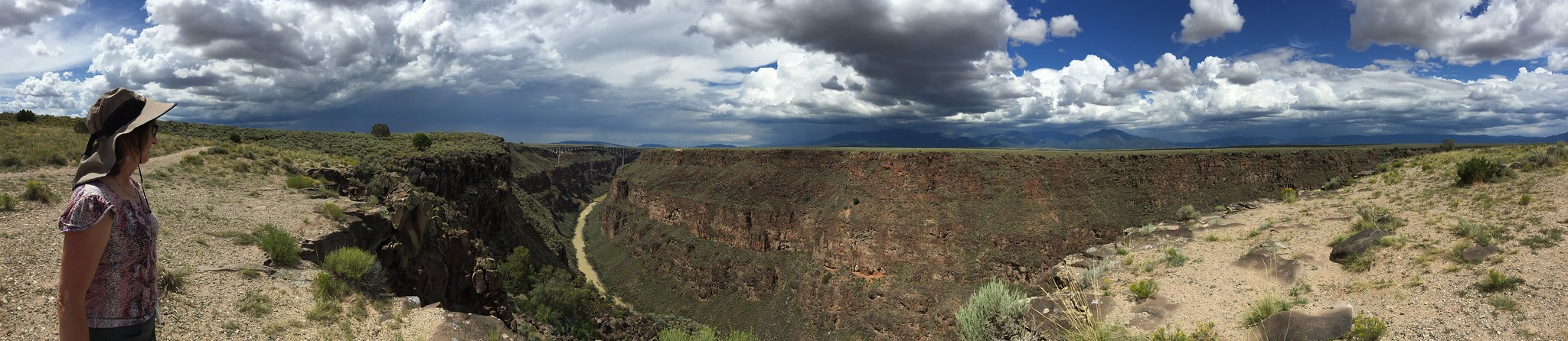
Incident at Rio Grande Gorge Bridge

"Your tire is about flat." The woman had not yet started her car, but came out to have a look.

"Oh, no!" she said. She pulled out her phone.

We were just finishing our lunch at a shady spot near the Rio Grande Gorge Bridge, and the lovely Carol was thinking to spend some time reading. Feeling my "damsel in distress" button pressed, I walked around the car as said damsel was folding up her phone, looking dejected. I made a sympathetic noise, and asked her if she had a spare. She did, "But…"

Carol chimed in around here with "my husband would probably be happy to help." So that's what we did. The damsel (probably about our age actually), who I'll call "Erin," was driving a 2003 Nissan SUV, on which she had never changed a tire. I looked under the car, and saw a full-sized spare. Nice! But Erin was hesitant. It has been quite a while since she'd changed a tire, and had little memory of how to do it. Have I mentioned that she'd pushed my "damsel in distress" button?

Erin opened the hatch and removed some equipment. Under the floor we found some tools: a hex wrench and a rod with a "T" at one end. "Where's the jack?" I wondered, and started to lift the tool tray out. I found some resistance, and after a moment, also found a wing-nut, which I started to loosen. Erin took over, spinning the wingnut counterclockwise while I gradually lifted an edge of the tool tray, and there I found a jack. Success!

I wasn't sure where to place the jack, and I asked Erin if she still had the manual (when all else fails...). Sure enough, she did. I encouraged her to take her time and to follow the order of steps in the manual. There was one thing I forgot to make her do: engage the T-shaped rod to engage the spare-tire winch. But she did it herself at the end—catching my mistake of omission. Other than that, though, she did all the work. I told her what to do and how to do it, and she executed everything.

Carol was very supportive of this effort, noting that I was teaching Erin how to fish, rather than simply giving her one.

As we worked, and for some time afterward, Erin told us about her life and her travels, and also about her niece's travel.

It was a lovely time, and it was nice for me to feel useful on vacation. And we got something out of it, too. Carol asked her whether it was worthwhile to walk across the Rio Grande Gorge Bridge. Erin said it was, but she also recommended a trail that started just behind us. About a half-mile down is a bench, she said, and the view from there is fabulous. We took the half-mile or so walk, and sure enough, the view was well worth the 10-15 minute walk. Photos were taken. Truly a win-win adventure.

Wednesday, July 22, 2015

Saved!—by Rock'n'Roll?

I've been watching bits of the Oscar-winning 2014 documentary 20 Feet from Stardom. About half an hour in, we hear about Merry Clayton's duet with Mick Jagger on Gimme Shelter; you can see an excerpt on youtube.

Gloria Jones, who was a gospel singer and also sang with Joe Cocker and T. Rex, spoke on the film about this: "What I liked was that she could sing. She was able—to be Merry. She didn't have to (gesturing) bring it down." I found her next comments (not in the youtube excerpt) remarkable: "Everybody was telling us we had to 'bring everything down,' so when the rock'n'roll world came and said, 'No, we want you to sing, it saved us. Saved us. Saved our lives."

Why would Jones say that gospel singers like herself and Merry Clayton needed saving? (According to this openculture story and others, Clayton was the daughter of a Baptist minister and sang in her father's church.) This put me in mind of two other quotes. The first is from Barbara Brown Taylor:

The problem is, many of the people in need of saving are in churches, and at least part of what they need saving from is the idea that God sees the world the same way they do.
― Barbara Brown Taylor, An Altar in the World: A Geography of Faith
downloaded from goodreads July 2015

The second is from Kent Haruf's lovely novel, Eventide. In an earlier volume, we meet the McPherson brothers, bachelor farmers who take in a homeless pregnant teen-ager. As Eventide begins, Victoria is leaving for college with her little girl, and the brothers are helping her move into her apartment. The manager wonders if they're her grandfathers or uncles:

We're not related that way, Victoria said. They saved me two years ago when I needed help so badly. That's why they're here.

They're preachers, you mean.

No. They're not preachers. But they did save me. I don't know what I would've done without them. And nobody better say a word against them.

I've been saved too, the girl said. I praise Jesus every day of my life.

That's not what I meant, Victoria said. I wasn't talking about that at all.

Victoria was saved from homelessness and poverty. And from alienation. "I don't know what I would've done without them," she said.

The apartment manager was saved from… eternal death? I assume she means her sins have been forgiven and that she will be made perfect in the world to come. She has what we in the church call "assurance of salvation," the promise of eternal life. This is no small thing, but somehow she comes off as faintly ridiculous.

Barbara Brown Taylor writes about being saved from a wrong notion about God. This is huge, actually. If our ideas about God are far enough away from the truth, we'll find ourselves worshiping and obeying some other god. This is not good.

The salvation Gloria Jones speaks about is somehow not quite as serious—but maybe it is: she, and Merry Clayton and the others, were saved from a life of not being able to really express themselves—of feeling in some way unacceptable, unapproved, not cherished for who they really are.

I'm sorry to say that we in the church sometimes treat women this way; some congregations don't accept the idea of women as elders; some won't listen to a woman teach. In the churches where Jones and Clayton worshiped, they didn't even want women to really sing.

But rather than go on a rant here, I want to say that in this world we all have our blind spots. As Curt Thompson notes in The Anatomy of the Soul, many of us are simply doing the best with what we have. Or something close to it anyway.

Imagine if you will a group, a community, a congregation, where we all think the only thing we need saving from is a set of things we call "sins," and maybe something unpleasant after this present life. We don't think we need to be saved from illusions about God, we don't think we need to be saved from distraction or folly that lead us to live futile lives.

If I were in a congregation like that, how introspective might I be, or not be? How willing might I be to question the status quo? And if the status quo meant that women in our group, my sisters in the Lord, should be told to sing [or not] in a certain way, how likely would I—or anyone—be to try to change things? It would take some sort of awakening, probably the intrusion of the Spirit of God, perhaps in the voice of a prophet; and a willingness in the congregation to hear and accept something that makes them feel uncomfortable.

So the McPherson brothers saved Victoria Roubidoux from poverty and alienation and homelessness. Reflection and self-examination and openness to the Spirit of God can save us from folly and oppression. And if we encourage someone to truly be themselves, to be the person God meant them to be, we can prevent [maybe even relieve] a sense of shame about who they are—and save ourselves from being oppressors as well.

And we do need to be saved from becoming one of the oppressors, one of those people who put others down and lord it over them. Even the early disciples needed saving from that:

25Jesus called them together and said, “You know that the rulers of the Gentiles lord it over them, and their high officials exercise authority over them. 26Not so with you. Instead, whoever wants to become great among you must be your servant, 27and whoever wants to be first must be your slave— 28just as the Son of Man did not come to be served, but to serve, and to give his life as a ransom for many.”
Matthew 20:25-28 NIV

We all need saving, and I don't just mean we need to hear and believe the good news of Jesus. We also need to think correctly about who God is and how he sees things. And for goodness's sake, we need to be saved from being part of the oppressive congregation/gang/culture that denies dignity to our fellow human beings.

Which means we need—I need—to be open to the possibility that I'm part of the problem; I need to be willing to examine myself and to be willing to change my mind (or to repent, to use the jargon). So help me God.

Wednesday, July 01, 2015

Replacing front brake pads on a 2007 Honda Odyssey: When all else fails…

My niece said that the brakes on her 2007 Odyssey minivan were shot. "Are they squealing?" I asked. That was two weeks ago, she said. It's beyond that; now the noise was more like a scraping. She wanted to take it to Chevron to have them do the needful. My dad, who looks 77 though he'll be 92 pretty soon, said it would cost a fortune and they probably wouldn't be able to do it today anyway. He said we could Just Do It, to coin a phrase.

Where's the nearest auto parts…? It was O'Reilly's, where the old Pawaa (later "Cinerama") theater used to be. So I ran down there and bought a set of ceramic pads. I seemed to remember reading something from Ray Magliozzi (of "Car Talk") about how they stopped better and lasted longer than the plain vanilla ones, and were quieter and cost less than the super-deLuxe ones. While the clerk was fetching the parts, I looked at the book rack. There was a Chilton's repair manual for the Odyssey, 2001-2010 or so. How much? $29, she said. I figured it would pay for itself, but I didn't know at the time that payback would be within half an hour.

I returned to the house to find that Dad had brought out an impact driver and a tool box, and was getting ready to remove one wheel. I tracked down the car's jack and started elevating the right front (passenger) quarter of the car.

We removed the wheel and the hubcap promptly fell off. This struck me as weird: the hubcap is held on by the lug bolts. Anyway, Dad pointed out the caliper mounting bolts. I started trying to loosen the top one, but didn't make much headway. I mean, I could whack the far end of my 14mm box wrench with my hand and it would move—either direction!—yet it never got looser. Same with the lower one. Finally, in desperation, I decided to RTFM and discovered two very important things:

  1. Remove only the bottom bolt—don't touch the top one; and
  2. When trying to turn the bolt, use another wrench (19mm open-end) to hold the retaining nut.
Whoa! That was the big surprise. And thank goodness I decided to buy the manual. Without it, I don't know how many advice pages and youtube videos I would have looked at.

As far as other surprises, I forgot to replace the clips on the front-right brakes; when doing the front-left (driver side) I remembered. Naturally I remembered the anti-squeal brakes on the right side but almost forgot it on the left, but Neil mentioned it and I added it.

The manual also had the hint of using a C-clamp to compress the brake pistons. Fine idea, but we didn't need it. My "doing what comes naturally" plan worked fine.

The driver-side pads were definitely shot. The "squeal to alarm the driver when the pad gets too low" indicator had sheared off, and the wear indicator was gone, too, indicating that yes, the pads were toast (the passenger-side pads still had some wear left in them). We didn't replace the rotors as this was a rush job. I told my niece, and her husband: Next time, replace the rotors too.

Monday, June 29, 2015

Why we thought it was a good idea

Some years ago I read about the paradox that whereas parents report lower levels of happiness during the child-raising years than childless couples do, they later remember those years as happier times than their childless counterparts.

I've wondered about this on and off, and a few days ago found a possible explanation. I was reading Atul Gawande's marvelous book Being Mortal, where he mentioned an interesting study of patients who experienced painful medical procedures while awake. (The experiment was one of a series recounted by Nobel laureate Daniel Kahneman in his book Thinking, Fast and Slow.) These patients were asked throughout their procedures to rate the level of pain on a scale of one to ten. “At the end, the patients were also asked to rate the total amount of pain they experienced during the procedure.” (237)

The patients' final ratings were not even close to the sum of their moment-by-moment ratings; rather, “[t]heir final ratings largely ignored the duration of pain. Instead, the ratings were best predicted by what Kahneman termed the ‘Peak-End rule’: an average of the pain experienced at just two moments—the single worst moment of the procedure and the very end.”(237)

Indeed, it seems to apply to a lot of experiences in life, not just surgery and child-raising.


In my own case, as I look back on my own experience in raising two wonderful daughters, I remember the positive experiences more than the negative ones. When we were living in Japan, our younger child attended local schools. They had taken the kids to visit a shrine, and our daughter reported to us that the children had been expected to stand in a certain place, bow, and clap. (No church-state separation there!) "But of course I didn't do it," she added.

She had interpreted the ritual -- correctly I think -- as a prayer to the god of that place, and I was so grateful that our young child had the spiritual discernment to understand she was being asked to worship another god, and also the intestinal fortitude to resist the pressure to conform.

I also recall keenly when our older daughter, then 13, said to a roomful of parents and school officials, "I want to know what will be done to address what happened today." (What had happened didn't include physical violence, but a teacher did behave quite badly. I do not think she was a bad person, but she was certainly in the wrong job.)

The principal, momentarily dumbfounded, asked what our daughter had in mind. "She should apologize to us," she said, "and some of us should apologize to her." Did I mention that our daughter was 13 when she said this?

Do I remember any negative experiences? Well, there's what probably amounted to the stupidest thing I've done as a parent -- which I don't think I've confessed on this blog.

There were times when I was sure one of our kids had reached a new plateau of unreasonableness (this happened more than once). I remember that it happened, and I remember using that bit about the new plateau (I was pleased with myself for coming up with it too). But I don't remember with any clarity what triggered the exasperation, or even the feeling itself; those memories have faded into oblivion. I also know that we had some nights of very little sleep, some hours of continuous screaming and wailing from a restrained child, epic cleanup experiences (you don't want to know), discussions about why you really shouldn't bite your sister, and other things like this... but not very clearly.

Which may be why someone referred to them as "Collin's perfect children": I know my daughters aren't perfect, but I have a hard time locating their faults.